
Hey there, fellow digital marketing enthusiasts and tech-savvy minds! As a woman navigating the dynamic world of online advertising, I’m always looking for smart, efficient ways to manage campaigns and get the most out of our ad spend. Today, we’re diving deep into a topic that often gets overlooked but can truly revolutionize your Google Ads management: the Google Ads shared budgets bid strategy.
If you’ve ever managed multiple campaigns, you know the daily dance of juggling individual budgets. It can feel like playing a constant game of “guess the spend,” trying to ensure each campaign gets enough love without blowing your overall budget. That’s where shared budgets step in, offering a more flexible and often more effective approach to budget allocation.

What exactly is a shared budget in Google Ads?
At its core, a shared budget is exactly what it sounds like: a single, overarching budget that multiple Google Ads campaigns can draw from. Instead of setting a fixed daily budget for Campaign A, Campaign B, and Campaign C separately, you create one shared budget for them all.
The beauty of this approach lies in its dynamic nature. Rather than rigidly dividing your funds, Google’s system intelligently distributes the budget among the linked campaigns. If one campaign is hitting a high-performance streak and could generate more conversions with a little extra push, the shared budget allows it to scale up, drawing funds from the communal pot. Conversely, if another campaign is having a slower day, its unspent portion can be reallocated to where it’s needed most. This means your budget is always working smarter, not just harder, seeking out the best opportunities for return on investment.
The benefits of shared budget
Let’s break down the compelling advantages:
Maximized overall performance: this is the big one. Instead of rigid daily caps per campaign, a shared budget allows Google’s algorithms to prioritize spending on campaigns that are performing best at any given moment. This means your total budget is directed towards the most impactful opportunities, leading to a higher overall return on ad spend (ROAS) across your account.
Simplified budget management: say goodbye to the tedious task of constantly adjusting individual campaign budgets. With a shared budget, you set it once, and Google’s system takes care of the dynamic allocation. This frees up significant time, allowing you to focus on more strategic tasks like ad copy optimization, keyword research, audience targeting, and overall campaign strategy.
Reduced overspending and underspending: shared budgets inherently smooth out spending fluctuations. On a low-demand day for one campaign, its budget isn’t wasted; it becomes available for another campaign experiencing higher demand. This flexibility helps prevent budget caps from hindering strong performance and ensures your overall spend is utilized efficiently, minimizing both wasted spend and missed opportunities.
Improved budget allocation for new campaigns: launching a new campaign can be tricky when it comes to initial budget allocation. With a shared budget, a new campaign can immediately tap into the existing, optimized pool, allowing it to gain traction faster and find its footing without needing a separate, rigid budget to be set.
Leveraging Google’s advanced algorithms: while AI isn’t the sole focus, it’s undeniable that Google’s powerful machine learning algorithms are at the heart of shared budget optimization. These algorithms continuously analyze real-time data points – including auction insights, conversion probabilities, historical performance, and user behavior – to make instantaneous decisions on where your budget can achieve the best results. This intelligent allocation is a key differentiator from manual budget distribution.
Best time for a shared budget
While shared budgets offer incredible flexibility, they aren’t a one-size-fits-all solution. They work best in specific scenarios:
- Similar campaign goals: shared budgets are most effective when applied to campaigns that share similar objectives, such as maximizing conversions, driving website traffic, or increasing leads. Grouping campaigns with disparate goals (e.g., brand awareness vs. direct sales) under one shared budget might lead to suboptimal allocation.
- Cross-campaign synergies: if your campaigns target similar audiences or products, a shared budget can help ensure that the best-performing ad groups or keywords receive the necessary budget to scale.
- Accounts with consistent spending: shared budgets thrive on consistency. If your account has highly erratic spending patterns or very distinct, isolated campaign objectives, individual budgets might still offer more precise control.
- Utilizing automated bidding: shared budgets truly shine when combined with Google’s smart bidding strategies like “Maximize Conversions,” “Target CPA,” “Target ROAS,” or “Maximize conversion value.” These automated strategies work in tandem with the shared budget to not only allocate funds but also optimize bids for your desired outcome, making the entire process highly efficient.
Setting up your shared budget
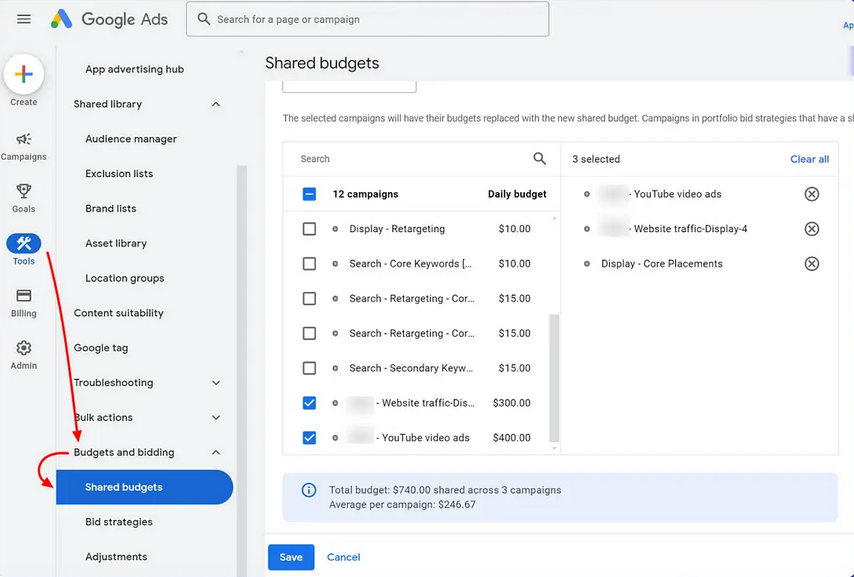
Ready to give this powerful strategy a try? Here’s how you can set up a shared budget in your Google Ads account:
- Log in to Google Ads: access your account from your browser.
- Navigate to “Tools and Settings”: in the top right corner of your Google Ads interface, click on the wrench icon (σ).
- Under “Shared Library,” Select “Budgets”: this section is where you’ll create and manage all your shared budgets.
- Click the Blue Plus button (+): this action will prompt you to create a new shared budget.
- Give your budget a name and set the amount: choose a descriptive name that helps you easily identify the budget (e.g., “Performance Max Budget,” “Brand Campaigns Shared”). Then, enter the average daily amount you wish to spend across all the campaigns linked to this budget.
- Select the campaigns to include: this is the crucial step. Link all the campaigns you want to draw from this new shared budget. Remember to unlink any existing individual budgets from these campaigns first, as a campaign can only use one budget at a time.
- Save! Once you hit save, Google’s system will begin optimizing your spending across the selected campaigns. Give it some time to learn and adjust for optimal performance.
Boost your shared budget results
Implementing a shared budget is just the first step. To truly unlock its full potential, consider these best practices:
Group campaigns strategically: don’t just throw all your campaigns into one shared budget. Group campaigns that are genuinely similar in their goals, target audiences, and expected performance. For instance, you might have one shared budget for all your lead generation campaigns and another for e-commerce product sales.
Monitor overall account performance: while shared budgets reduce the need for daily micro-management, it’s still crucial to monitor your overall account performance regularly. Look at total conversions, conversion value, and ROAS across all campaigns within the shared budget.
Combine with automated bidding strategies: as mentioned, shared budgets are most powerful when paired with Google’s Smart Bidding strategies. These algorithms work hand-in-hand to ensure your budget is not only allocated efficiently but also bid effectively for conversions.
Allow for a learning period: when you implement a shared budget, Google’s system needs a “learning period” to understand how to best allocate your funds. Don’t expect immediate, dramatic results. Give it a few days or even a week to optimize before making significant changes.
Review budget amount periodically: your business needs and market conditions can change. Regularly review your shared budget amount to ensure it still aligns with your overall marketing goals and desired spending capacity.
Don’t over-segment campaigns unnecessarily: sometimes, marketers create too many highly segmented campaigns, each with a tiny budget. A shared budget can actually help consolidate and optimize spending across these smaller, related segments, often leading to better overall results.
Summary
The shift towards shared budgets and sophisticated, AI-driven optimization is a clear sign of where Google Ads is heading. By embracing these powerful tools, we can move beyond manual, time-consuming optimizations and focus our energy on higher-level strategic thinking: crafting compelling ad copy, identifying new market opportunities, and ultimately, delivering exceptional results for our clients and businesses.
What are your thoughts on shared budgets? Have you implemented them in your Google Ads campaigns? Share your experiences, tips, or any questions you have in the comments below! Let’s continue to learn and grow together in this exciting and ever-evolving world of digital advertising.