
I came across a Reddit post a few months ago that made me wonder about the real scale of this recurring problem — how do we make sure our ads reach potential customers rather than competitors from the same industry? This topic is especially relevant for local service providers and small businesses, where every advertising euro matters and choosing the right channels can make or break the results.
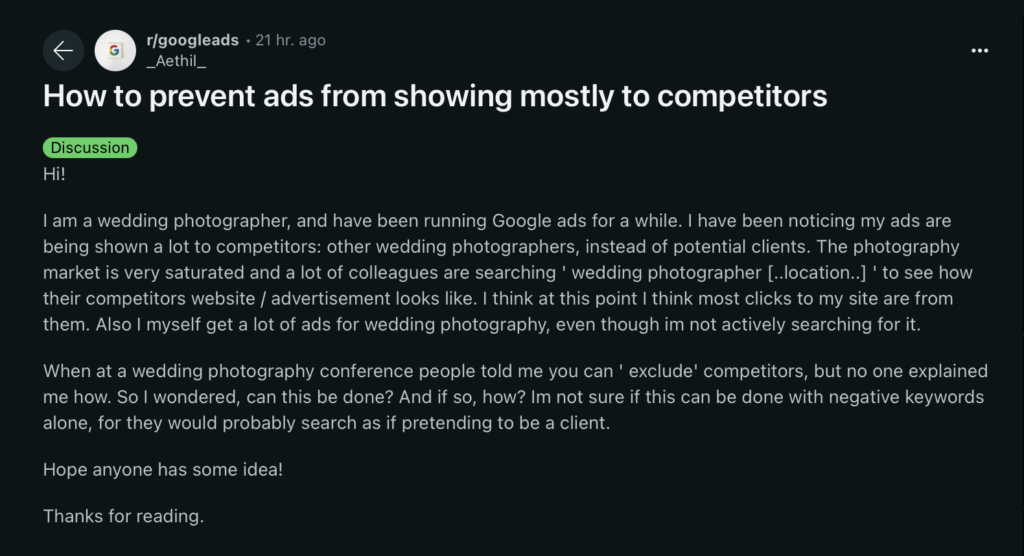
If you’ve been running Google Ads for more than a week, you’ve probably noticed a slightly annoying pattern: your ads seem to show more often to your competitors than to your actual customers. And honestly? That’s completely normal. Every industry has its own group of people who start their morning with a coffee and a quick search of “what are others doing?”. They type your keywords, click your ads, check your pricing, scroll through your landing pages, and sometimes even go deep into your funnel – purely out of curiosity.
And of course, Google sees all of this and happily marks those interactions as “strong engagement signals”. Which means your ads become even more likely to appear for people whose only goal is to monitor the market, not to buy anything from you.
But here’s the good news: while you can’t completely stop competitors from seeing your ads, you can significantly reduce how often it happens — and avoid wasting budget on people who will never convert. Below are the strategies I use for clients when ads start attracting more curious marketers than real customers.
The first step is a brutally honest look at your Search Terms report. If you spot competitor brand names, “X vs Y” queries, price comparisons, review searches, or anything that screams “industry research” — add those to your negative keywords immediately. Ideally, add them to a shared negative list so all campaigns stay protected. Sounds obvious, but many accounts quietly burn through hundreds (or thousands) of euros every month on exactly those irrelevant clicks.
Next: layer your targeting. Keywords alone are not enough anymore. Google relies heavily on audience signals, so use them to your advantage. Add in-market, affinity, and – most importantly – custom segment audiences built on your real customers’ intentions. When done well, this becomes an invisible shield: even if a competitor types the same keyword, they’re far less likely to match your audience profile.
Another underrated method is creating a dedicated landing page for your Google Ads traffic. Keep it simple, fast, and conversion-focused – without obvious navigation or links to your entire website. Competitors usually bounce faster from these pages, and Google receives fewer signals from them. Real customers, on the other hand, tend to engage more deeply, which strengthens the relevance of your traffic.
Then come the smaller, highly effective fixes:
– check your Geo report — competitors typically cluster in major cities;
– adjust your bids or split campaigns by device, especially desktop (a favourite playground for marketers);
– exclude competitor domains and YouTube channels from Display and Video campaigns.
At the end of the day, this isn’t about hiding from competitors — that’s impossible and unnecessary. It’s about making sure your budget works harder for you than for them. You want your ads to appear primarily to people who are ready to buy, book, subscribe, or ask for a quote. And with the right combination of exclusions, audience signals, and smart targeting, you can get incredibly close to that.