
Since news shot us in December 2024 that Google was officially bringing Standard Shopping Campaigns back into market, marketers have been in great euphoria. This doesn’t mean that this type of campaign has completely disappeared (unlike its automatic big brother Smart Shopping Campaign), but it has given way to Performance Max, which has been favoured by all of Google’s algorithms. In this article, we will take an objective look at the differences between these campaigns to leave you with thoughts and reflections on shopping ads in the years to come at the end. Let’s go!
Shopping ads strategy
Google Ads has revolutionized the way e-commerce businesses market their products, providing powerful tools to reach audiences and drive conversions. Among these, two of the most popular options are the Performance Max Campaign and the Standard Shopping Campaign. Both aim to boost sales and maximize results, but they follow diverse strategies, each with its strengths and limitations.
If you’re an e-commerce business or digital marketer unsure which campaign to use, this article will break down their key differences, advantages, and use cases. By the end, you’ll be equipped to make an informed decision for your ad strategy.
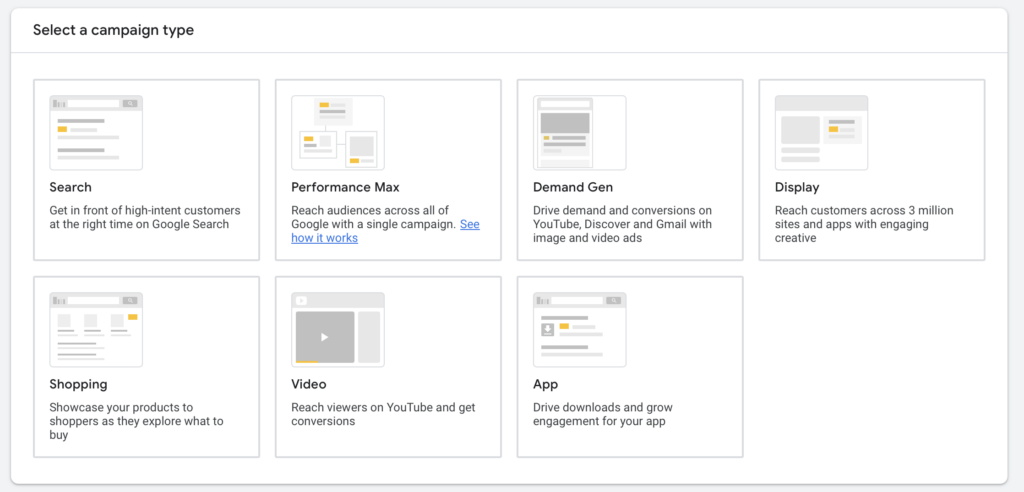
After you pick shopping, be careful because you need to confirm it twice:
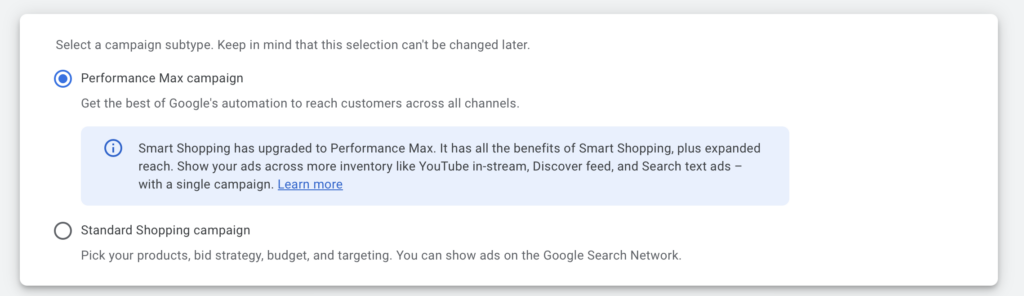
Performance Max
Performance Max (PMax) is Google’s cutting-edge, fully automated campaign type that uses AI and machine learning to drive ads across all of Google’s networks, including Search, Display, YouTube, Discover, and Gmail.
Here’s how it works:
- You set campaign goals (e.g., driving sales or leads).
- You provide assets like text, images, and videos.
- Google’s AI takes over to optimize placements, bidding, and formats in real time based on user intent and behaviors.
This automated approach saves time and effort, making Performance Max a great option for businesses with broad targeting needs and sufficient data to support Google’s algorithms.
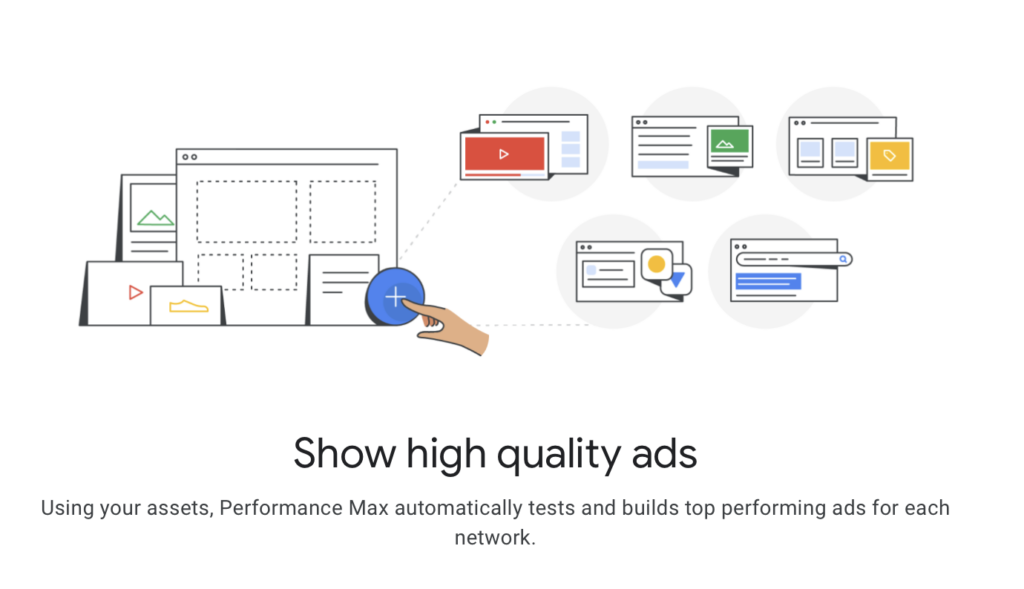
Key benefits of Performance Max
- Maximum reach: ads are shown across multiple Google platforms
- Automation and efficiency: AI handles targeting, ad placement, and bidding
- Scalability: ideal for large-scale campaigns with minimal manual monitoring
However, Performance Max sacrifices some control. Marketers are often unable to see granular insights, such as specific keyword performance or audience data.
Standard Shopping Campaign
Standard Shopping campaigns are designed to display product ads in Google Shopping and Search results when potential customers actively search for relevant products. These campaigns rely on structured product feeds, which include titles, descriptions, prices, and images uploaded to Google Merchant Center.
Compared to Performance Max, Standard Shopping requires more manual control, allowing advertisers to handle targeting, bidding, and ad placements more precisely.

Key Benefits of Standard Shopping:
- Tighter control: advertisers manually define targeting, bidding, and keywords
- Granular insights: detailed performance reports allow for optimized decisions
- Low data dependency: works well even with limited historical data
The drawback, however, is that scaling Standard Shopping campaigns can become labor-intensive as you manage more products and bids.
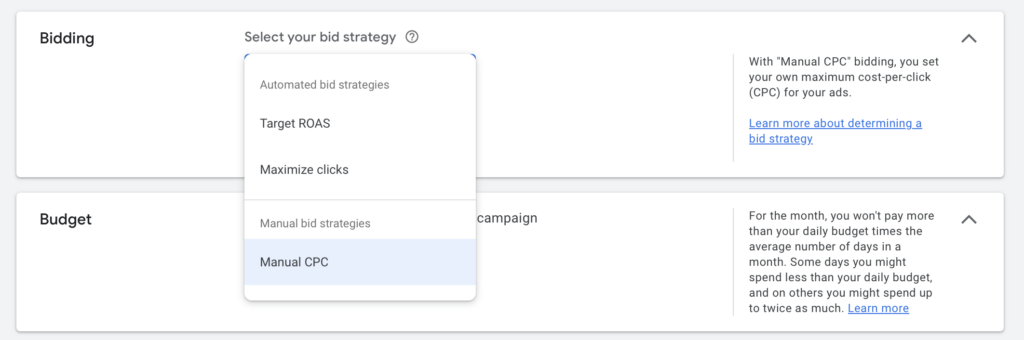
Bidding and budget
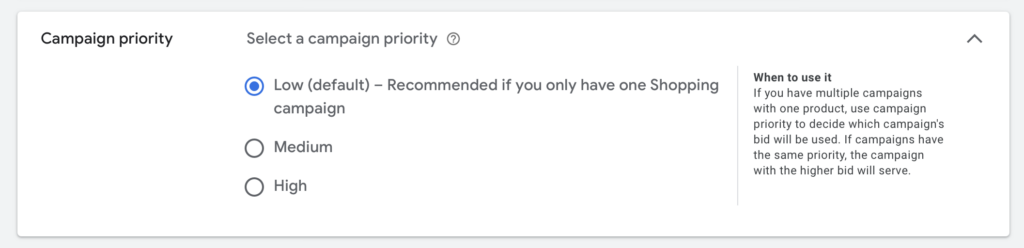
Campaign priority
Key Differences Between Performance Max and Standard Shopping
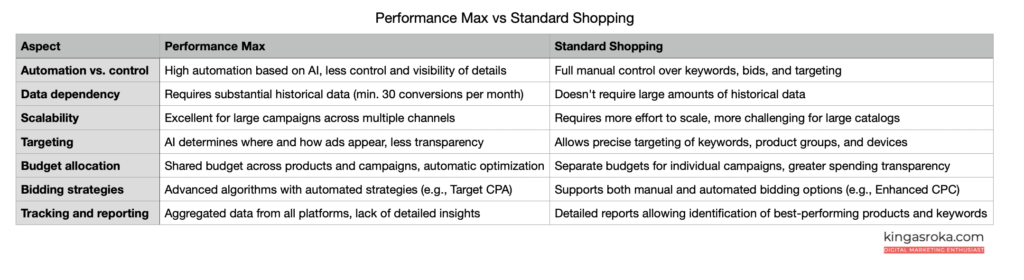
1. Automation vs. control
- Performance Max uses automation powered by AI, leaving little need for manual adjustments. However, this comes at the cost of reduced visibility and control over specific targeting details.
- Standard Shopping offers hands-on control, allowing you to tweak keywords, bids, and audience targeting yourself.
Recommendation: If you value control over brand safety and ad placement, opt for Standard Shopping. Performance Max might be better suited if you prefer a “set it and forget it” approach.
2. Data dependency
- Performance Max requires a substantial amount of historical data (e.g., at least 30 conversions per month) to function optimally. Without this, the AI struggles to optimize bidding and targeting efficiently.
- Standard Shopping doesn’t heavily rely on data, making it more suitable for businesses with fewer conversions or limited audiences.
Recommendation: For startups or businesses with minimal data, start with Standard Shopping. If you’ve built enough historical data, consider transitioning to Performance Max for better scalability.
3. Scalability
- Performance Max excels in handling large-scale campaigns across multiple channels, adjusting bids automatically to maximize performance across platforms.
- Standard Shopping requires more manual effort to scale, which can be challenging for businesses managing hundreds of products.
Recommendation: Performance Max is a better choice for scalability, especially for enterprise-level campaigns or those targeting multiple networks simultaneously.
4. Targeting
- Performance Max uses AI to determine where and how your ads appear, based on search history, demographics, and intent signals. However, the exact criteria the algorithm uses are rarely visible, which might impact decision-making.
- Standard Shopping allows granular targeting, letting you specify keywords, product groups, and devices.
Recommendation: For niche products or highly specific targeting strategies, choose Standard Shopping. Performance Max is better for broad-reaching campaigns that rely on automated optimization.
5. Budget allocation
- Performance Max uses a shared budget across multiple products and campaigns, readjusting in real time to maximize ROI across platforms.
- Standard Shopping requires separate budgets for individual campaigns or target groups, offering greater transparency in spending.
Recommendation: Performance Max is ideal for streamlined, automated budget management. However, if you want more control over spend allocation, Standard Shopping might suit your needs better.
6. Bidding strategies
- Performance Max incorporates advanced algorithms with automated bidding strategies such as Target CPA (Cost Per Acquisition) and Maximize Conversions to optimize results continually.
- Standard Shopping supports both manual bidding and automated options, like Enhanced CPC, offering flexibility to match your goals.
Recommendation: Performance Max’s sophisticated bidding works well for campaigns with sufficient data. For advertisers wanting to control bids manually, Standard Shopping is preferable.
7. Tracking and reporting
- Performance Max aggregates data across all platforms, offering a holistic view of campaign performance. However, it lacks detailed insights into individual platform results.
- Standard Shopping provides granular reporting, allowing you to identify high-performing products, keywords, and audiences.
Recommendation: If reporting depth is critical to optimizing your strategy, Standard Shopping wins. Performance Max is better for advertisers focused on top-level campaign performance.
When should you use each campaign?
The choice between Performance Max and Standard Shopping ultimately comes down to your business goals, experience level, and the resources available.
Use Performance Max if:
- You have large-scale campaigns and sufficient historical data to train Google’s AI
- Your priority is maximizing reach across multiple channels
- You prefer automated processes to save time and effort
Use Standard Shopping if:
- You want granular control over your campaigns’ targeting, bidding, and placements
- You are a smaller company with limited data or budgets
- You need detailed reporting to inform future strategies
Making the right choice
For businesses with lower budgets or those still learning the ropes of Google Ads, I recommend starting with Standard Shopping to gain control and comprehensive insights. Once your campaigns have stabilized and you’ve generated sufficient conversion data, transitioning to Performance Max can help scale your efforts while saving time.
Regardless of the campaign type you choose, always track ROI and adjust your strategy based on data insights. Google Ads can deliver outstanding results if you align your marketing efforts with clearly defined goals.